Abstract
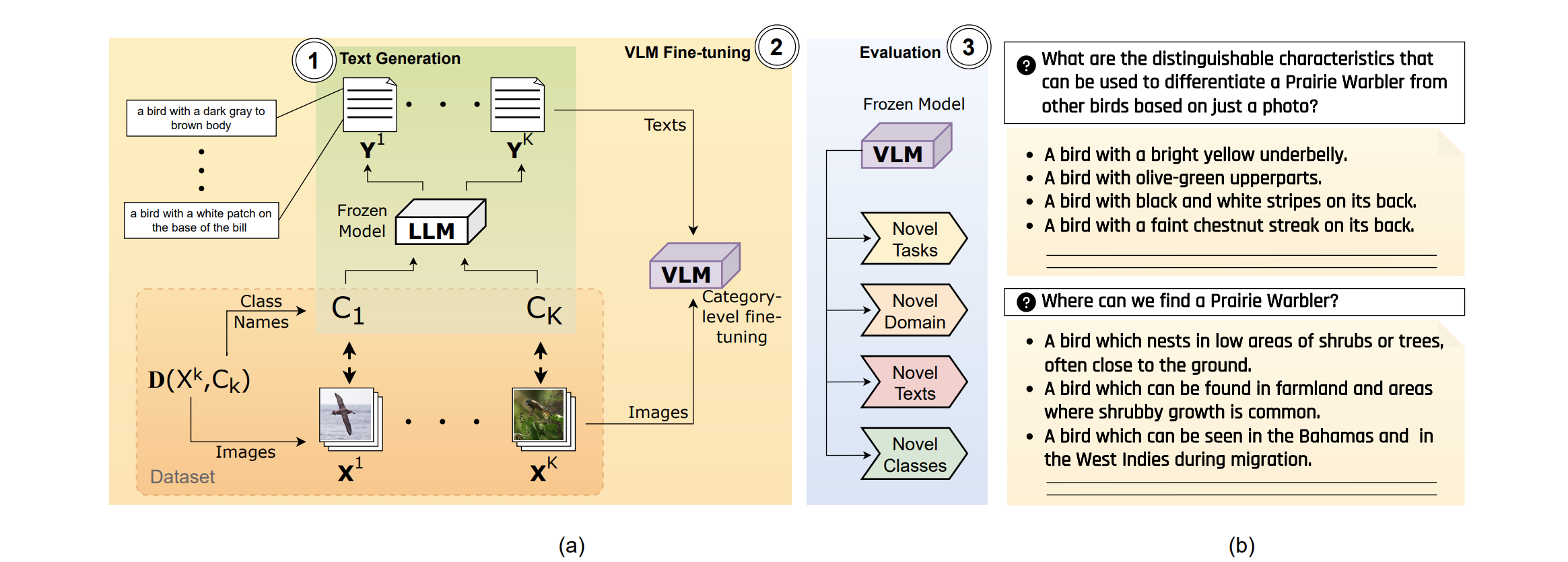
The zero-shot performance of existing vision-language models $($VLMs$)$ such as CLIP is limited by the availability of large-scale, aligned image and text datasets in specific domains. In this work, we leverage two complementary sources of information—descriptions of categories generated by large language models $($LLMs$)$ and abundant, fine-grained image classification datasets—to improve the zero-shot classification performance of VLMs across finegrained domains. On the technical side, we develop methods to train VLMs with this “bag-level” image-text supervision. We find that simply using these attributes at testtime does not improve performance, but our training strategy, for example, on the iNaturalist dataset, leads to an average improvement of 4-5% in zero-shot classification accuracy for novel categories of birds and flowers . Similar improvements are observed in domains where a subset of the categories was used to fine-tune the model. By prompting LLMs in various ways, we generate descriptions that capture visual appearance, habitat, and geographic regions and pair them with existing attributes such as the taxonomic structure of the categories. We systematically evaluate their ability to improve zero-shot categorization in natural domains. Our findings suggest that geographic priors can be just as effective and are complementary to visual appearance. Our method also outperforms prior work on prompt-based tuning of VLMs.
- Task: zero-shot classification with VLMs
- Problem Definition: limited by the availability of large-scale, aligned image and text datasets in specific domains
- Approach: leverage two complementary sources of information: 1) descriptions of categories generated by LLMs, and 2) abundunt, fine-grained image classification dataset